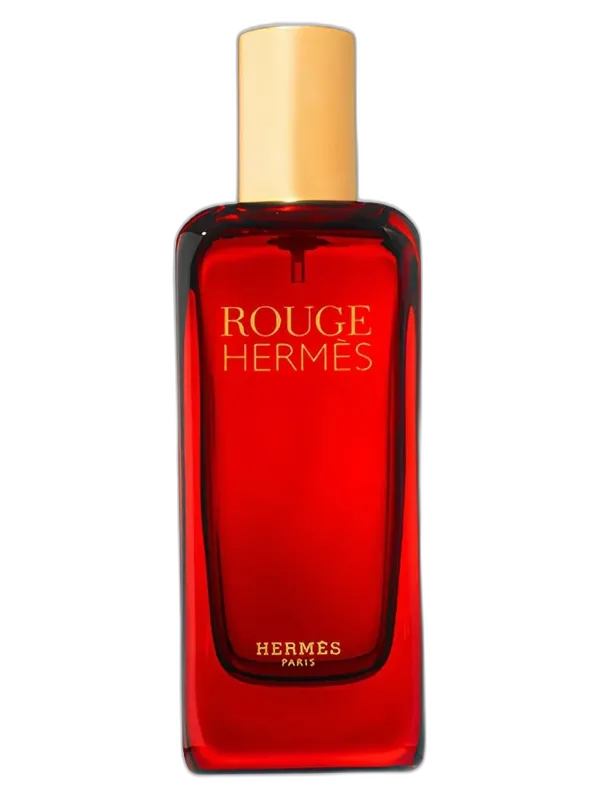
Our take
What does Rouge smell like?
Rouge sits within Hermès' tradition of French ambery florals, richer in construction than the transparent compositions the house would later favour. The opening is warm and sparkling at once: a leathery, almost metallic saffron meets fizzing aldehydes and a bergamot that lights up the whole. In the heart, rose, iris and jasmine melt into a powdery bouquet that suggests rouge, face powder and the red velvet of a theatre box. The base of amber and musk, shaded by a darker woody touch, brings enveloping resinous warmth. It is a perfume of character, more retro than modern, that needs to be worn with confidence.
When to wear it
Cool evenings and dressy occasions; it appeals to lovers of classic, powdery and slightly dramatic ambery florals.
The story of Rouge
Its full name is Rouge Hermès, and its story comes in two parts. In 1984 the house launched Parfum d'Hermès, composed by Akiko Kamei. Some sources also credit Raymond Chaillon. In 2000 Hermès reworked that formula and renamed it Rouge Hermès. That is the version still on sale, as an eau de toilette, while the 1984 original has been discontinued. The rename says something about the period. Around 2000, Hermès had not yet turned towards the sheer, transparent scents that Jean-Claude Ellena would make its signature. Rouge belongs to the older way of doing things: a rich, powdery floral amber that felt a little retro even at launch. One point worth knowing if you search for "Hermès rouge". Since March 2020, Rouge Hermès has also been the name of the house's lipstick line, its first beauty collection. The two are unrelated beyond a shared idea of colour. This page is about the perfume. It is a low-profile Hermès today, kept alive mostly by loyal wearers. That is a shame, because few current perfumes smell like it.
Our detailed review
The opening is brighter than you expect. Aldehydes give a fizzing powder effect. Saffron adds a warm and slightly leathery note, almost metallic. The bergamot is gone quickly. After half an hour the heart settles in and barely moves. Rose leads, thickened by jasmine. Iris adds the dry feel of face powder, like a compact you have just clicked open. The amber and musk base arrives slowly. It warms the rose without weighing it down, and the skin ends up smelling of velvet and lipstick. We like how consistent it is. It lives up to its name and does not try to please everyone. The flaw is obvious. It smells like a perfume from another era, and the aldehydes up top can recall a grandmother's dressing table. On some skins the saffron turns soapy. It suits lovers of powdery roses and classic florals who find modern releases too sweet. Anyone after a light, fresh Hermès will find it overdressed.
Rouge vs its rivals
24 Faubourg, also from Hermès, is the natural neighbour. Released in 1995 and composed by Maurice Roucel, it shares iris, jasmine and an ambery base. Orange blossom and gardenia make it sunnier and less powdery. Rouge is darker and, fittingly, redder. Guerlain's Nahema shares rose, jasmine and bergamot. Its rose is peachier and more balsamic thanks to Peru balsam and benzoin, and it is more opulent. Yves Saint Laurent's Paris pairs rose, iris and bergamot over amber and musk. Violet makes it sweeter and gentler. For a powdery rose with real character, Rouge is the most distinctive of the three. Nahema suits anyone who wants more opulence, and Paris anyone who prefers softness.
Longevity, projection and use
As an eau de toilette, Rouge Hermès lasts reasonably well, around five to seven hours. Projection is clear for the first hour, then it stays fairly close to the skin. Two or three sprays work, on the neck and inner wrists. The iris and musk cling well to wool and cashmere, where you can still smell them the next day. This is a cool-weather scent. It fits an evening out, a dressy dinner or a night at the opera. In high summer the aldehydes and amber feel heavy. At the office, one spray is enough.
It belongs to the Floral, Oriental / Amber family. Rouge is one of 47 creations by Hermès in our encyclopedia.