Our take
What does Allure smell like?
Jacques Polge created Allure in 1996 as a faceted perfume in which no single note takes the lead. The opening sets the plush roundness of downy peach against the brightness of mandarin and lemon, both juicy and crisp. The heart blends rose, jasmine and magnolia: a lemony, creamy flower that gives the composition its glow. It then slides into a softened vanilla held in check by dry vetiver and silky sandalwood, so the warmth stays elegant and never pastry-like. This is the house style of the period at its most refined: contrasts polished until the texture feels smooth, almost tactile, more like cashmere than a recognisable bouquet.
When to wear it
Versatile enough for a working day or a dinner out; it suits anyone after a refined yet easy perfume with no eccentricity.
The story of Allure
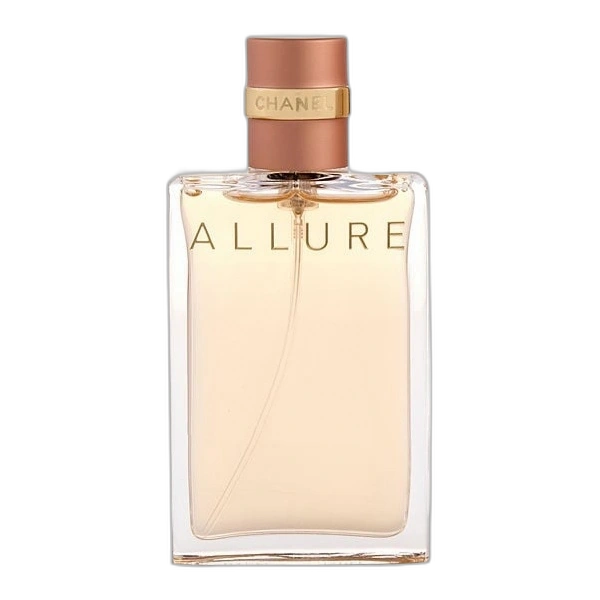
First, a clarification, because searches for "Coco Chanel Allure" mix two things up. Allure is not a version of Coco, the house's big 1984 oriental. It is a feminine in its own right, launched in 1996 and composed by Jacques Polge, Chanel's perfumer since 1978. The link to Gabrielle Chanel is the name. It borrows the title of L'Allure de Chanel, the book of her recollections gathered by Paul Morand. Allure later became the name of a whole family, which is where it gets confusing. Allure Homme arrived in 1999. It is a woody amber for men with no direct olfactory link to the women's scent. Allure Homme Sport followed in 2004, then Allure Homme Édition Blanche in 2008, all on the men's side. For women, the best-known spin-off is Allure Sensuelle from 2005, a darker eau de parfum that pushes patchouli and vanilla. This page covers the first one, women's Allure from 1996. It comes as eau de toilette, eau de parfum and parfum, meaning the extrait. The bottle is the house's plain rectangle. Thirty years on it sits in the shadow of Coco Mademoiselle and Chance, even though it has aged better than most scents of its decade.
Our detailed review
The opening is soft and bright. Peach brings fuzzy fruit while mandarin and lemon give it backbone. Nothing stings. In the heart magnolia leads the bouquet. It is a creamy flower with a lemony edge, rounded by rose and jasmine. After two hours it slides towards the base. The vanilla is there, but held in check by dry vetiver and sandalwood, so it reads as warmth and never as dessert. Think of a pale cashmere jumper, or clean skin with a hint of cream. If you only know Allure Homme, expect a surprise. The men's version is peppery and woody, the women's is round and floral, and they share little beyond the name. We admire how finely it is blended. Allure is the textbook case of smooth without flat. The criticism is that it plays safe. It never surprises, and some will find it impersonal or dated, the kind of perfume your mother wore. It suits women who want an elegant everyday scent. Anyone after more character should try the ambery Allure Sensuelle, or look elsewhere in the house.
Allure vs its rivals
Coco Mademoiselle from the same house shares rose, jasmine, vanilla and vetiver. It swaps peach for orange and lychee and has far more patchouli. It is more modern and drier, and sexier too. Dior's J'adore shares rose, jasmine and vanilla, with magnolia up top. Pear and melon make it fruitier. It is a golden bouquet where Allure is a texture. Lancôme's Trésor shares peach, rose and jasmine, plus sandalwood and vanilla. It is more powdery and rounder, and iris and lilac give it a nostalgic feel. For an elegant everyday floral amber, Allure is the most balanced of the four. Coco Mademoiselle suits those who want something more modern. J'adore is for flower lovers, and Trésor for fans of powder.
Longevity, projection and use
Which concentration you pick really matters here. The eau de toilette is the lightest, and Chanel describes it as a more relaxed take. The eau de parfum covered here is the closest to the extrait in character, with a more ambery base. Expect six to eight hours on skin from it, with clear projection for two hours before it settles into a close bubble. Two or three sprays are enough, on the neck and chest. The extrait is dabbed on the wrists. Allure works in every season except real heat, where the vanilla feels heavier. At the office it is ideal. For autumn, we reach for the eau de parfum.
It belongs to the Floral, Oriental / Amber family. Allure is one of 48 creations by Chanel in our encyclopedia.